Use Cases

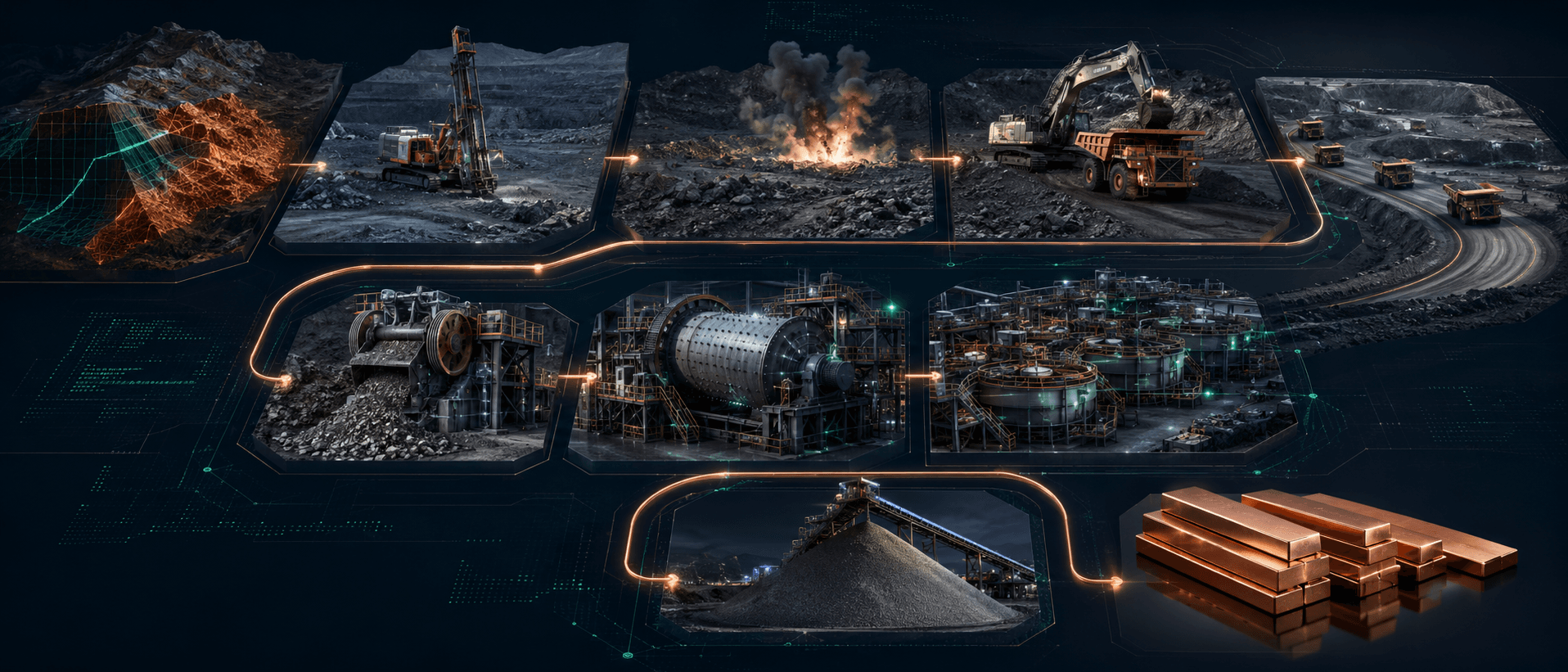
Mining-specific decisions, connected from resource to product.

OreNeda is designed for practical operating questions where local signals need to be understood as part of a wider mine-to-product system.

Practical stories

What the use cases look like in operation.

Each story shows how a practical operating question can become a connected decision workflow.

Story 01

Blast design before downstream cost appears

Situation: A technical services team is reviewing a blast design that meets local compliance but may push harder feed into the crusher and mill.

OreNeda: OreNeda compares the design against fragmentation, crusher load, grinding energy, recovery, and confidence assumptions.

Decision: Proceed, adjust burden and powder factor, or test an alternative pattern before execution.
Story 02

Stockpile draw when plant stability matters

Situation: A shift team needs to choose between stockpile draw options while grade, hardness, recovery response, and plant constraint risk are moving.

OreNeda: OreNeda links stockpile state, ore properties, routing flexibility, plant response, and product-quality targets.

Decision: Select a draw and routing strategy with the expected stability, recovery, and value trade-offs visible.

Story 03

Maintenance action framed by production exposure

Situation: A reliability warning appears on a critical asset, but the operating cost of acting now versus deferring is unclear.

OreNeda: OreNeda connects asset condition, warning history, production exposure, available operating windows, and constraint impact.

Decision: Prioritise maintenance, adjust operating mode, or continue monitoring with explicit risk and evidence.

Example workflow

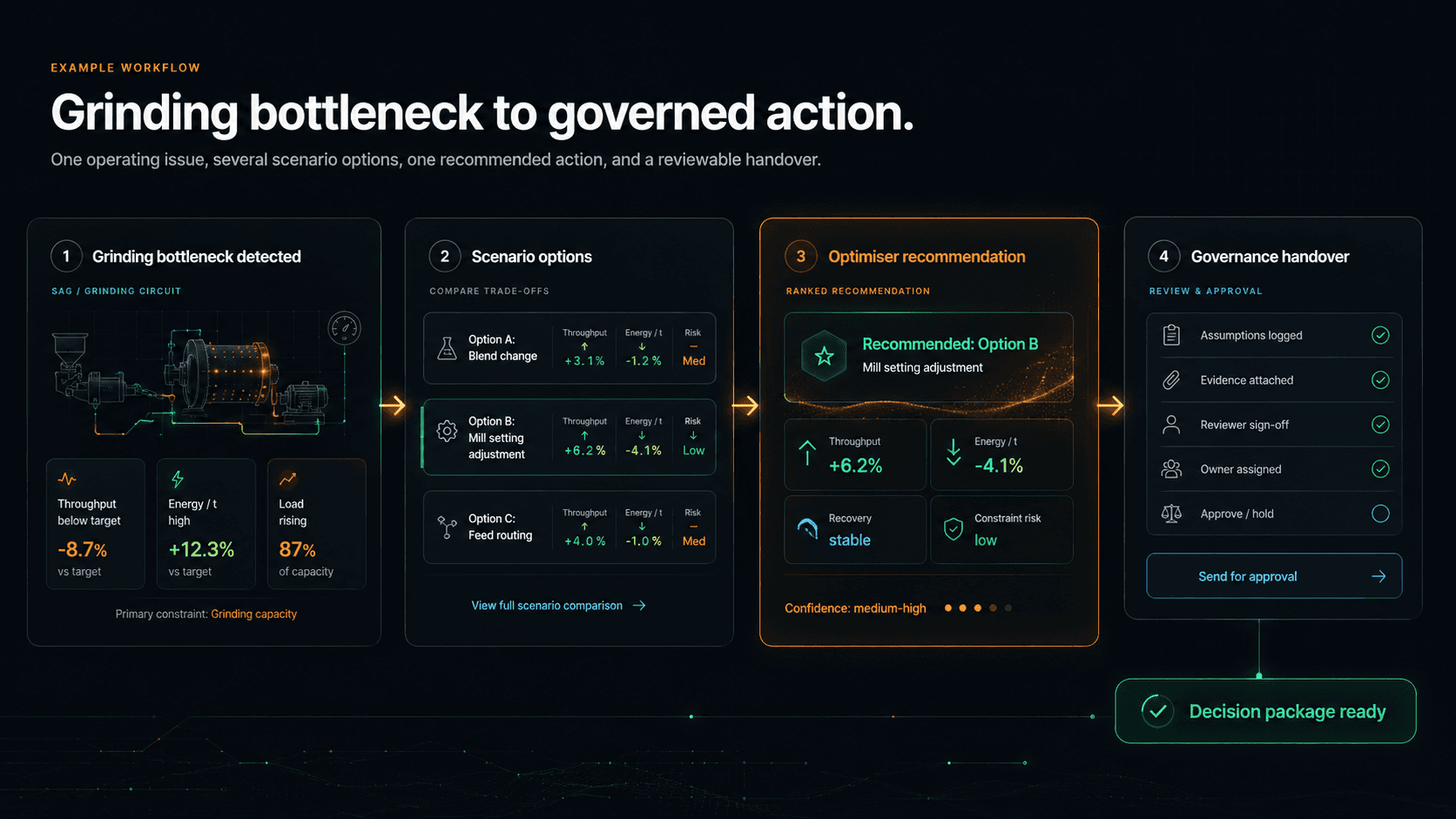
From bottleneck detection to governed action.

A grinding constraint becomes comparable scenarios, an optimiser recommendation, and a reviewable decision package.

Detect: expose the operating issue and primary constraint.

Compare: test scenario options against throughput, energy, recovery, and risk.

Govern: package the recommendation with assumptions, evidence, reviewer sign-off, and owner assignment.

OreNeda example workflow showing a grinding bottleneck detected, scenario options compared, optimiser recommendation selected, and governance handover prepared for approval.
Decision stories

Use cases grouped around the decision they improve.

Each story starts with the operating situation, then shows what OreNeda connects and the decision output it supports.

01 / Decision group

Mine-to-mill decisions

Technical choices that start upstream but show their consequences in crusher, mill, recovery, energy, and product outcomes.

Case 01

Drill and blast design review

Situation: Blast designs are often reviewed against local compliance without enough downstream visibility.

OreNeda connects: Pattern, geology, hardness, drill compliance, powder factor, fragmentation targets, vibration limits, plant constraints, and product quality.

Decision output: Proceed, adjust, or compare an alternative design before execution.

Case 02

Fragmentation and crusher performance

Situation: Fragmentation, crusher throughput, recirculation, and energy intensity are usually diagnosed too late.

OreNeda connects: Blast outcomes, feed size, ore domains, crusher settings, availability, recirculation, grinding load, and production plan.

Decision output: A feed strategy or blast adjustment recommendation with expected downstream movement.

Case 03

Plant throughput and recovery

Situation: Plant bottlenecks can be separated from ore characteristics, routing, and recovery-quality trade-offs.

OreNeda connects: Feed characteristics, crusher state, grind size, mill power, water, flotation response, recovery, product quality, and value.

Decision output: A recommended operating pathway with constraints, confidence, and expected KPI movement.

02 / Decision group

Operational control

Shift and short-interval decisions where teams need one operating picture instead of separate dashboards.

Case 01

Haulage productivity

Situation: Payload, queueing, cycle time, and dispatch choices are not always seen as system constraints.

OreNeda connects: Fleet status, route options, source material, destination, crusher demand, stockpile state, and production plan.

Decision output: A routing or dispatch adjustment that protects the wider value-chain objective.

Case 02

Stockpile and blending

Situation: Material routing must balance grade, hardness, recovery, logistics, and plant stability.

OreNeda connects: Ore parcels, stockpile inventory, grade, hardness, age, routing flexibility, plant response, and product target.

Decision output: A recommended stockpile draw or routing choice with traceable assumptions.

Case 03

Maintenance and asset risk

Situation: Asset health signals can be disconnected from production exposure and operational urgency.

OreNeda connects: Condition monitoring, reliability windows, production exposure, maintenance priority, constraints, and replacement risk.

Decision output: A maintenance or operating action prioritized by production risk and evidence.

03 / Decision group

Business and governance

Planning, reporting, and review workflows where technical evidence must be translated into decisions people can trust.

Case 01

Energy and water trade-offs

Situation: Energy, water, and emissions effects are often reported after production choices.

OreNeda connects: Operating settings, production plan, kWh/t, water intensity, emissions exposure, recovery, cost, and product value.

Decision output: A resource-efficiency recommendation grounded in operational constraints.

Case 02

Executive reporting

Situation: Leadership reports can compress complex operating issues into lagging KPIs.

OreNeda connects: Production, cost, recovery, energy, emissions, constraints, scenario outcomes, and decision evidence.

Decision output: An evidence-backed management narrative for review and alignment.

Case 03

Mine-to-product scenario planning

Situation: Scenario planning is slow when mine, plant, energy, commercial, and product outcomes are separated.

OreNeda connects: Mine plans, routing options, plant response, cost, recovery, energy, emissions, product quality, and constraints.

Decision output: A preferred scenario and evidence pack for technical or commercial review.

Use cases to pilot

Start with the decision that matters most.

OreNeda pilots are shaped around a focused workflow, the available site systems, and the evidence needed for confident review.

Validate a decision workflow.

Request a demo