Platform

A mine-to-product decision-support platform for operational trade-offs.

OreNeda connects site data, models, scenarios, constraints, and evidence so mining teams can compare choices before they become downstream consequences.

Product evidence

Real OreNeda platform screens.

The platform story is supported by working interface screens, with the decision proof point called out beside each image.

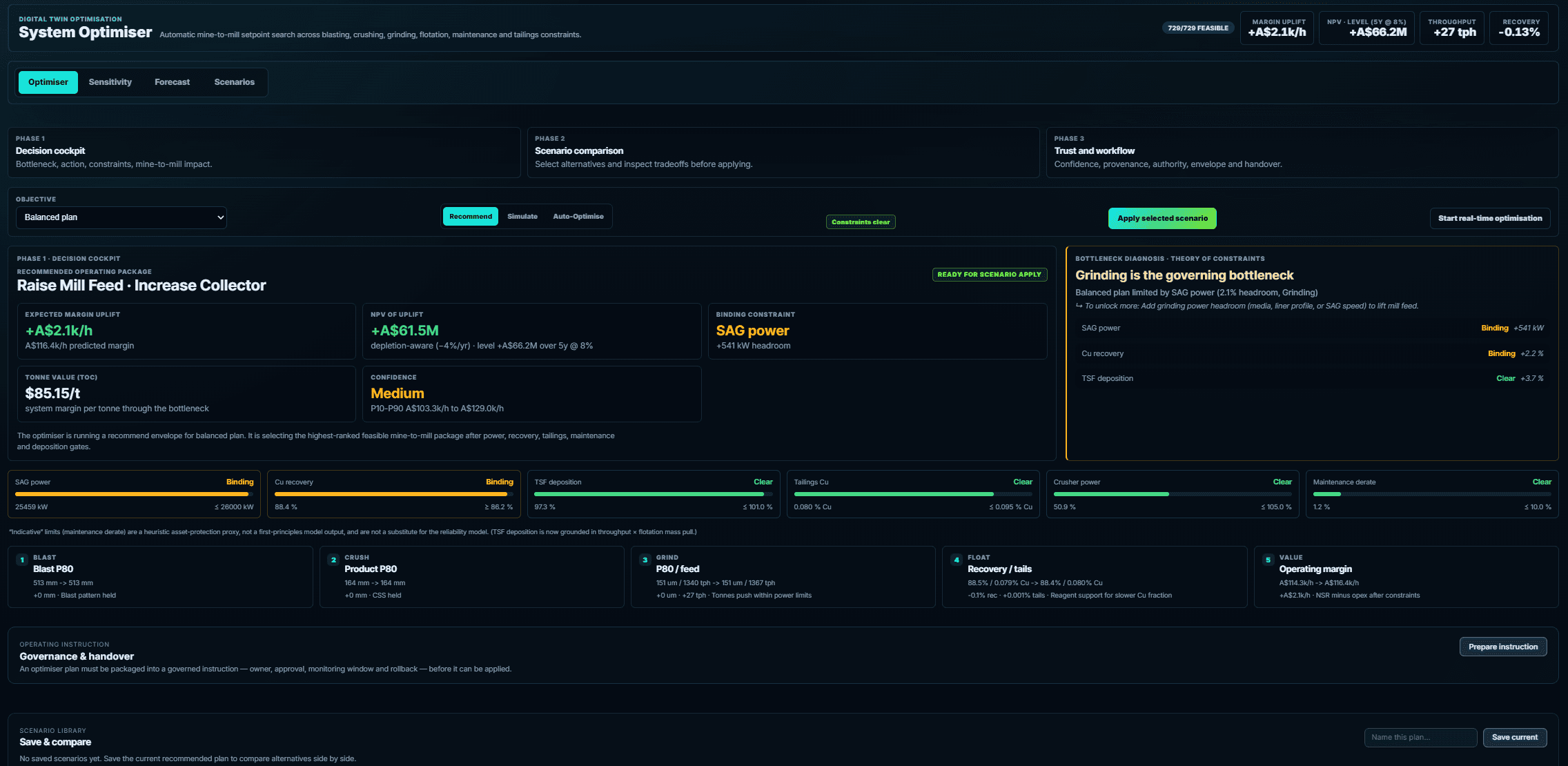
System optimiser

Rank feasible mine-to-product operating packages before applying a change.

Shows how OreNeda compares constraints, confidence, value movement, and downstream response to recommend an operating package across blast, crush, grind, float, and value outcomes.

Recommended packageBinding constraintGovernance handover
Prototype screen, illustrative data
OreNeda system optimiser screen showing a recommended operating package, margin uplift, NPV, throughput, recovery, SAG power constraint, confidence, value-chain steps, and governance handover.

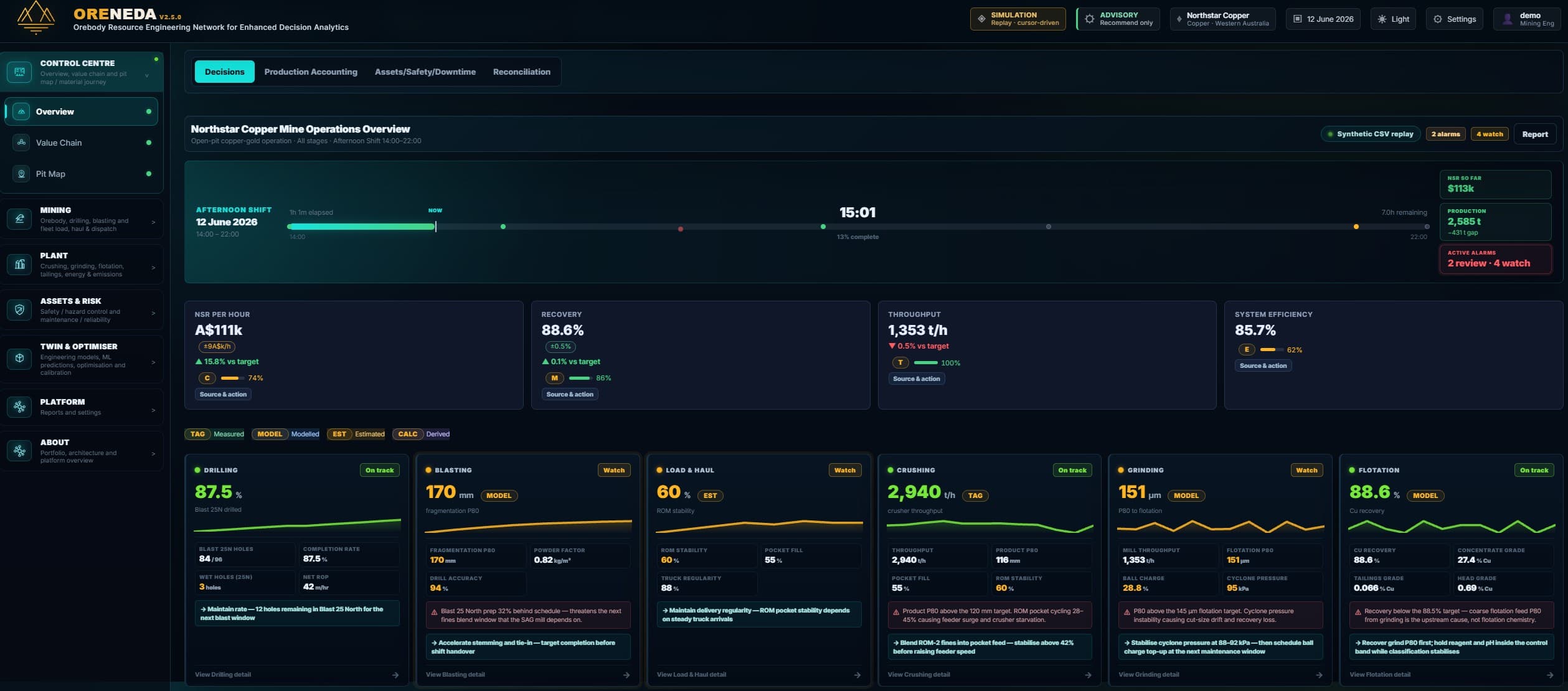
Control centre

Integrated operating view for shift, KPI, constraint, and value-chain review.

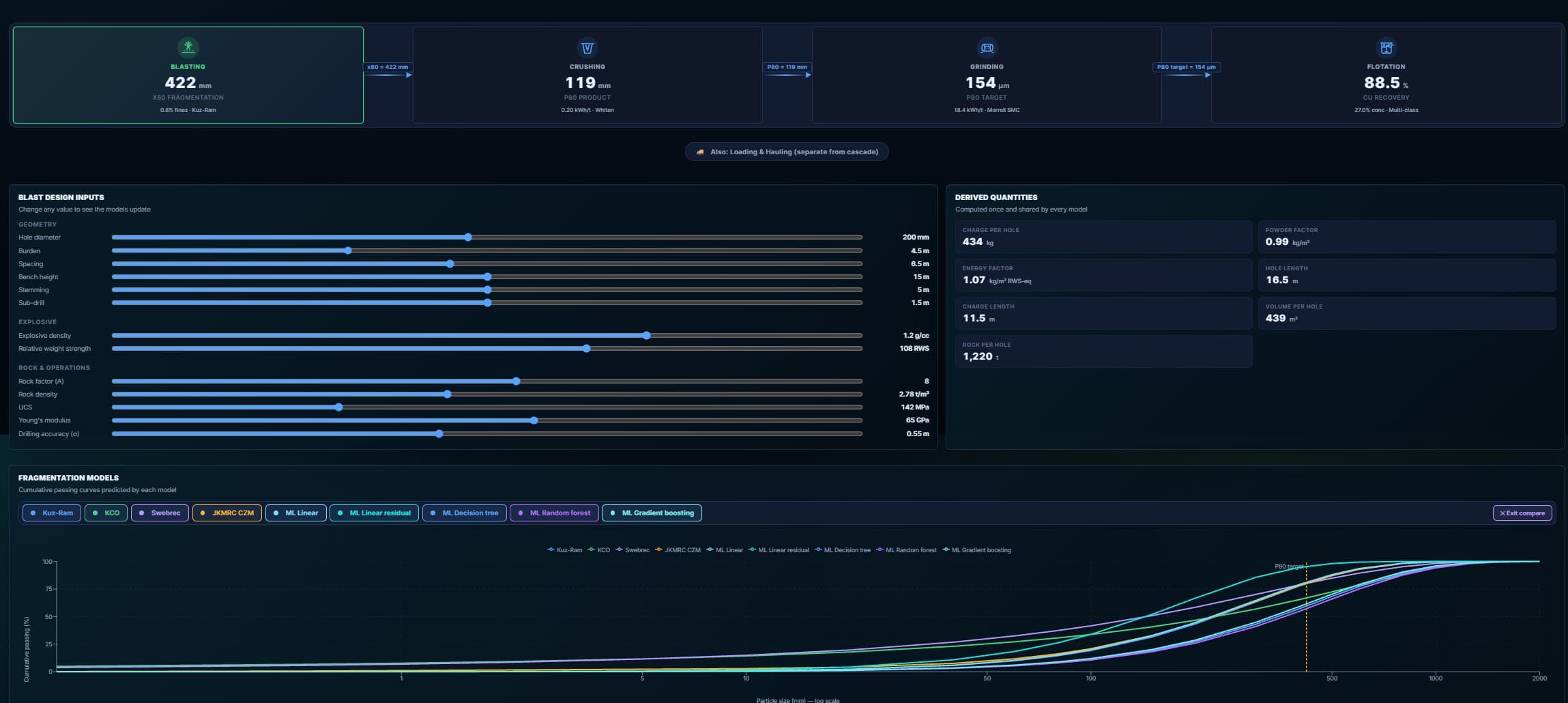
Shows how OreNeda brings shift state, constraints, KPIs, and value-chain modules into one operating review surface.

Shift and KPI contextActive constraintsValue-chain modules
Prototype screen, illustrative data
OreNeda control centre dashboard showing shift timeline, mining KPI cards, active constraints, and value-chain operating modules.

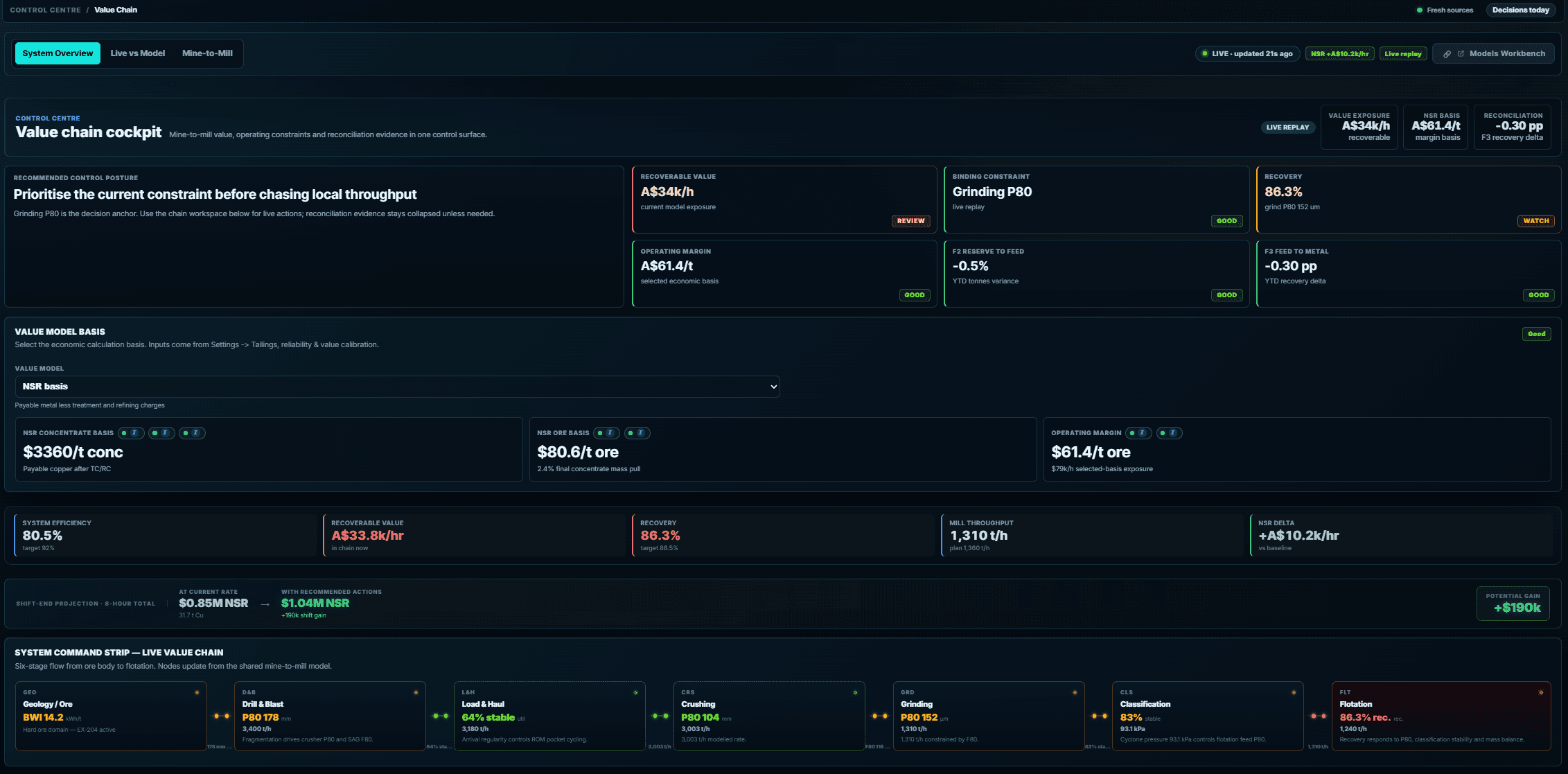
Value-chain cockpit

Recoverable value, grinding constraint, and command-strip state.

Shows how value, recovery, grinding constraint, and command state can be reviewed as one decision context.

Recoverable valueGrinding constraintCommand-strip state
Prototype screen, illustrative data
OreNeda value-chain cockpit showing recoverable value, grinding P80 constraint, recovery, NSR basis, and command-strip state.

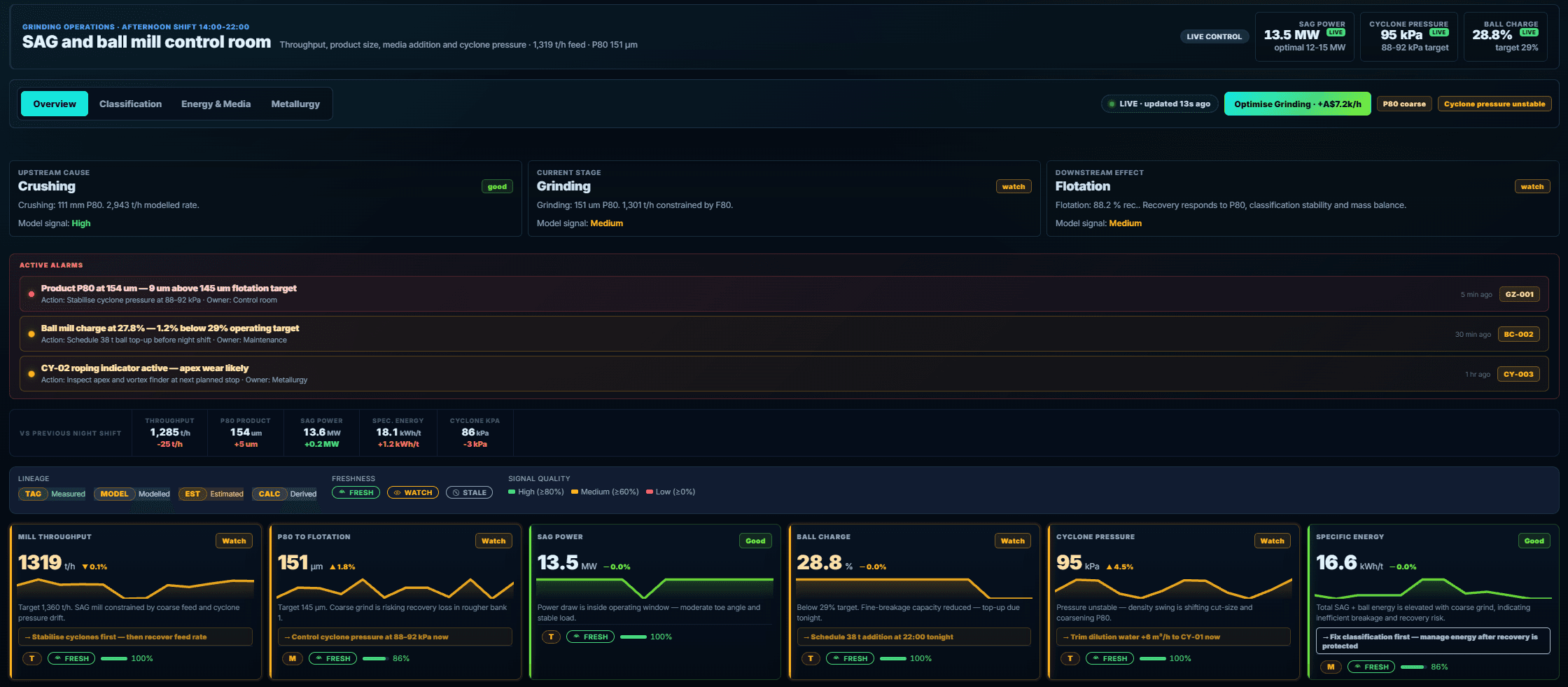
Recommendation and control

SAG power, cyclone pressure, alarms, and recommendation evidence.

Shows operating signals linked to alarms, recommended action, and evidence for plant-control review.

SAG and cyclone signalsAlarm contextRecommendation evidence
Prototype screen, illustrative data
OreNeda grinding control room showing SAG power, cyclone pressure, ball charge, active alarms, and control cards.

Operating pathway design

Design the value-chain pathway from resource to product.

Shows how OreNeda links upstream design choices, material movement, processing response, cost, energy, recovery, and product quality into one optimisation context.

Pathway designValue-chain constraintsOptimisation context
Prototype screen, illustrative data
OreNeda operating pathway design screen showing value-chain design choices, operating constraints, and optimisation trade-offs across resource, mining, processing, and product outcomes.
How it works

Five operating layers, one decision architecture.

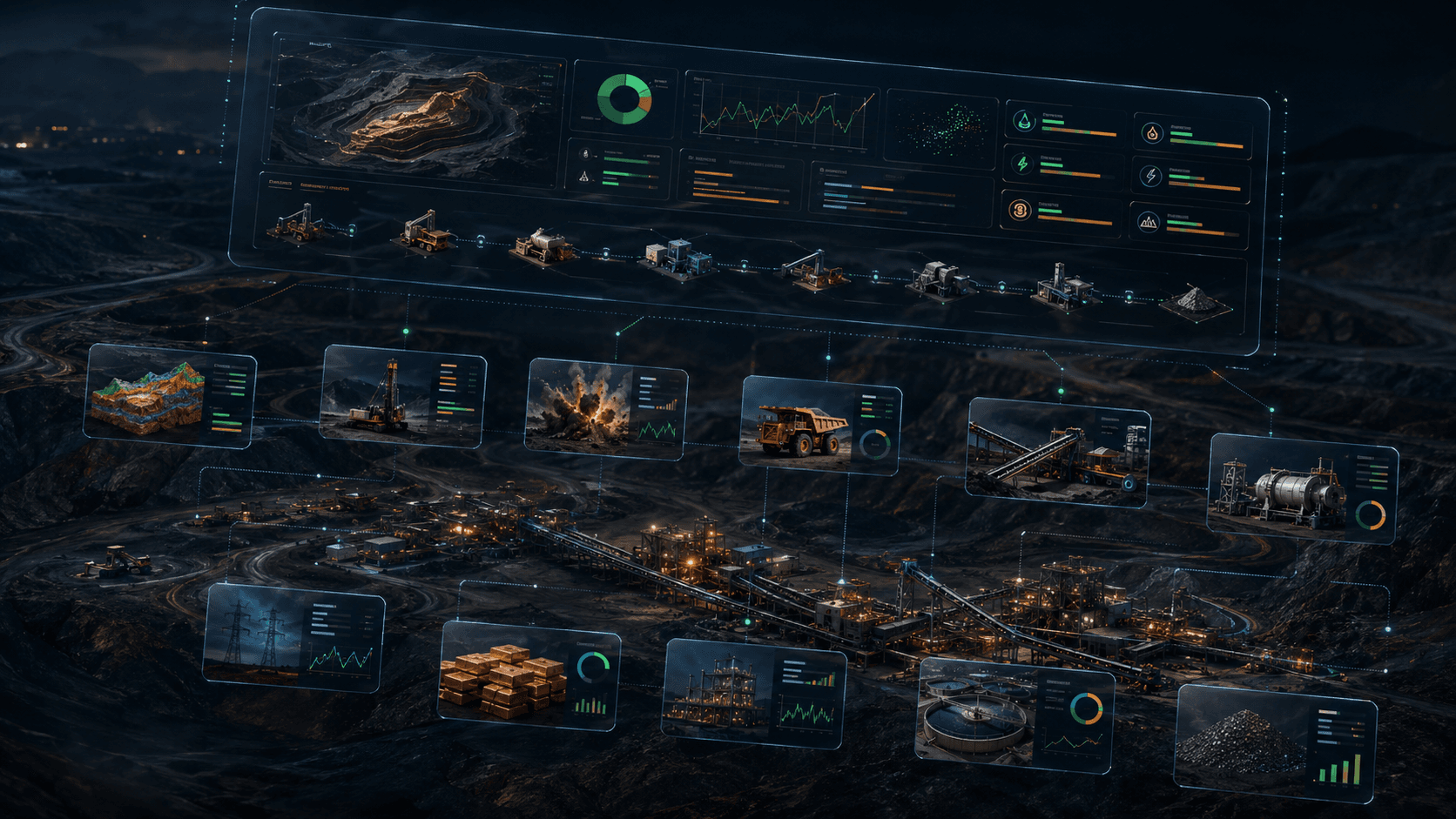
The platform is organised as connected layers: data foundation, scenario intelligence, resource-to-product traceability, operational visibility, and decision evidence. Together they explain how OreNeda turns site context into reviewable operating choices.

01

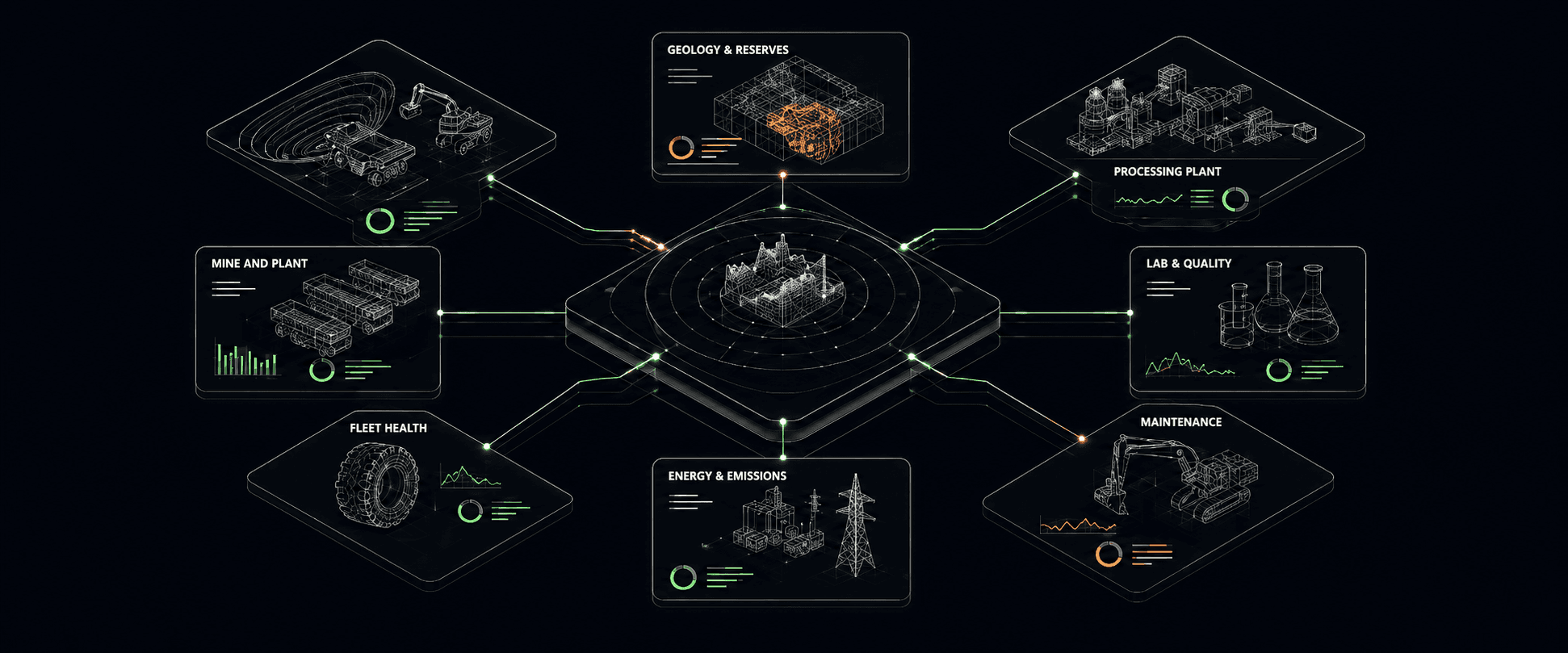
Connected data foundation

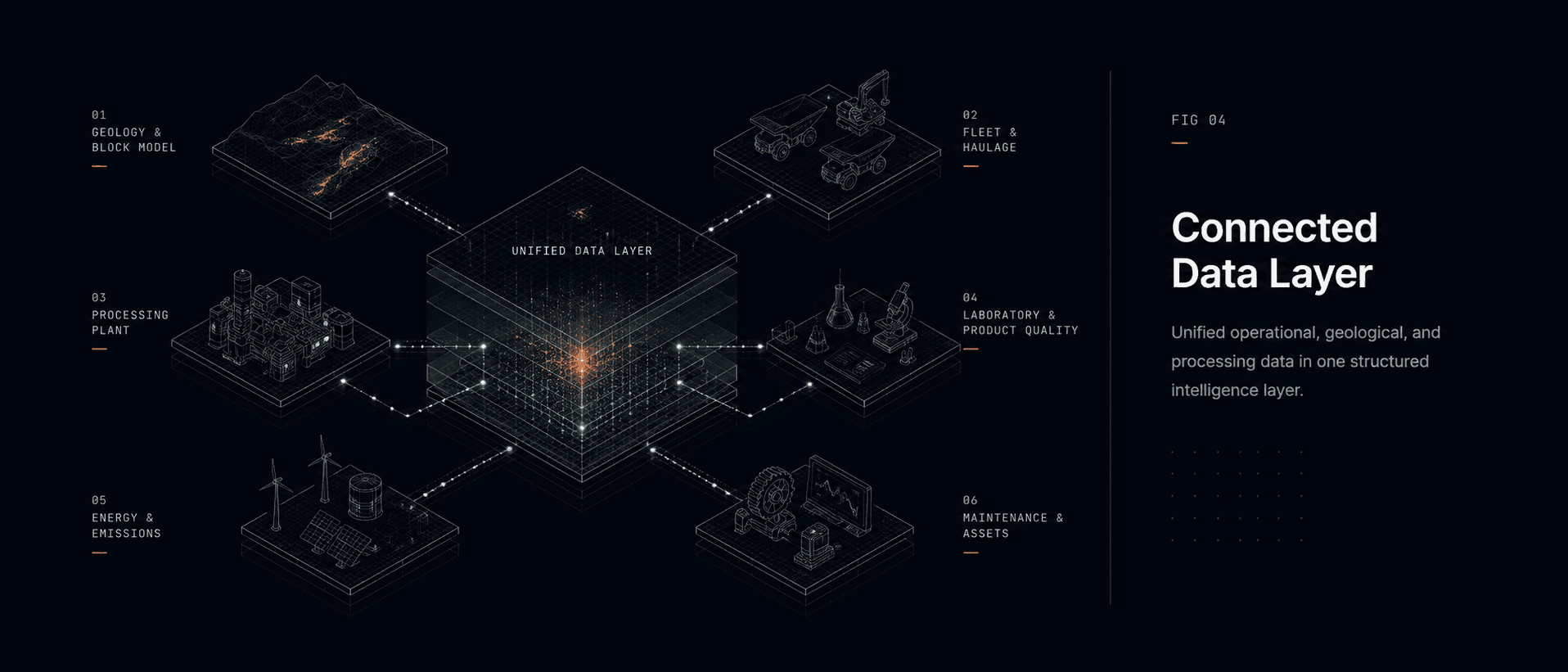
Unifies operational, geological, plant, laboratory, maintenance, energy, emissions, cost, and commercial data into one structured decision context.

Architecture role: Source map, data-quality context, and baseline decision view.
02

Scenario intelligence

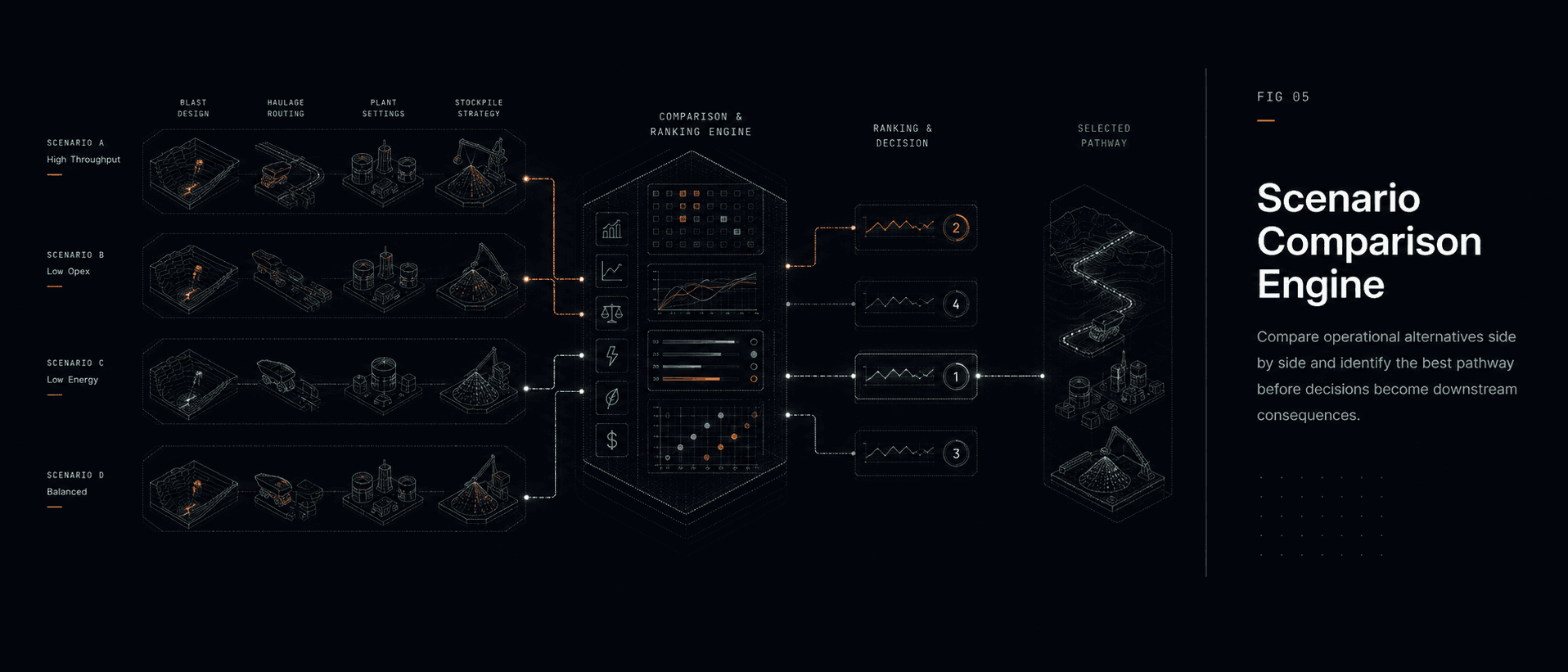
Compares operational alternatives before decisions become downstream consequences, with visible trade-offs across throughput, recovery, energy, cost, emissions, and value.

Architecture role: Ranked scenarios with expected trade-offs and a recommended pathway for review.

03

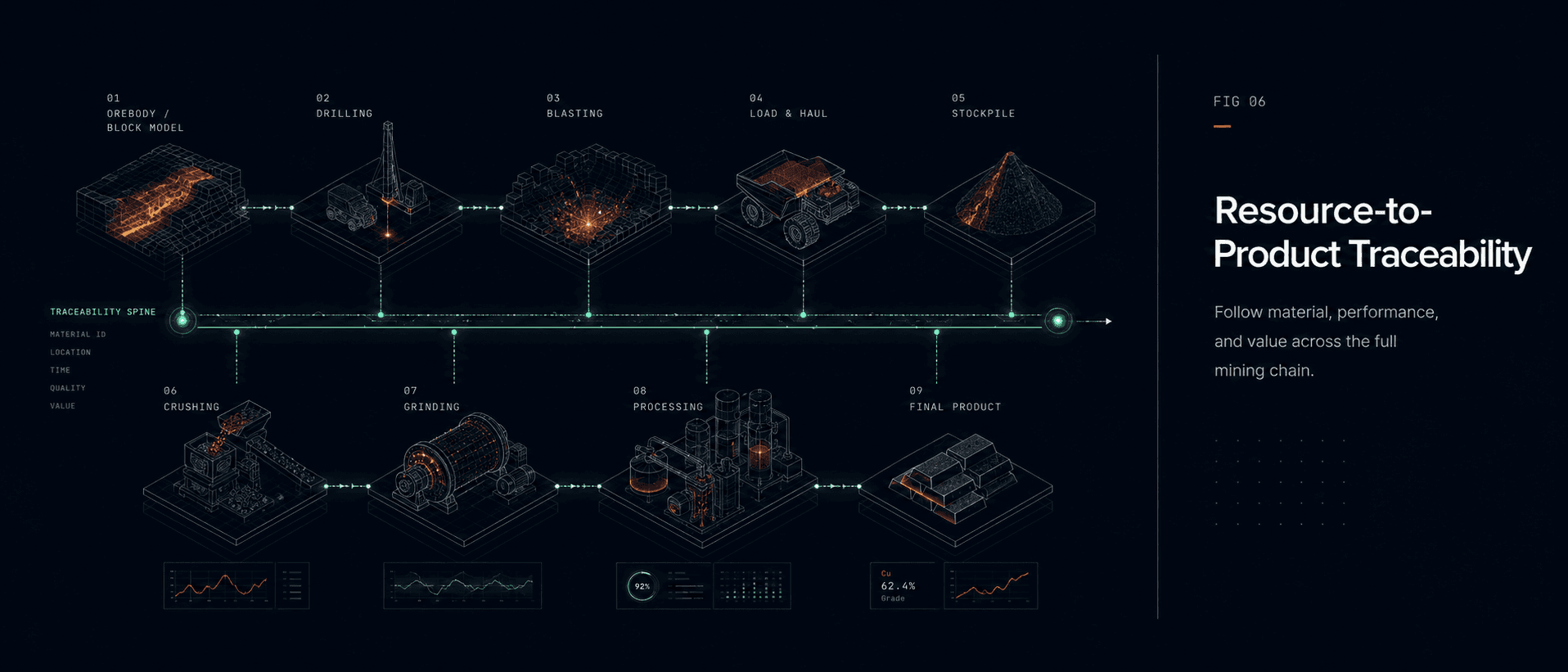
Resource-to-product traceability

Follows material, performance, and value from resource model to final product so teams can understand where outcomes were created, lost, or shifted.

Architecture role: Resource-to-product lineage with performance, value, and confidence context.

04

Operational-period visibility

Monitors constraints, KPIs, and operating signals across the mining value chain at the timing supported by site integration: near-real-time, shift-level, or operational-period visibility.

Architecture role: Operational-period control view with warnings, priorities, and decision context.

05

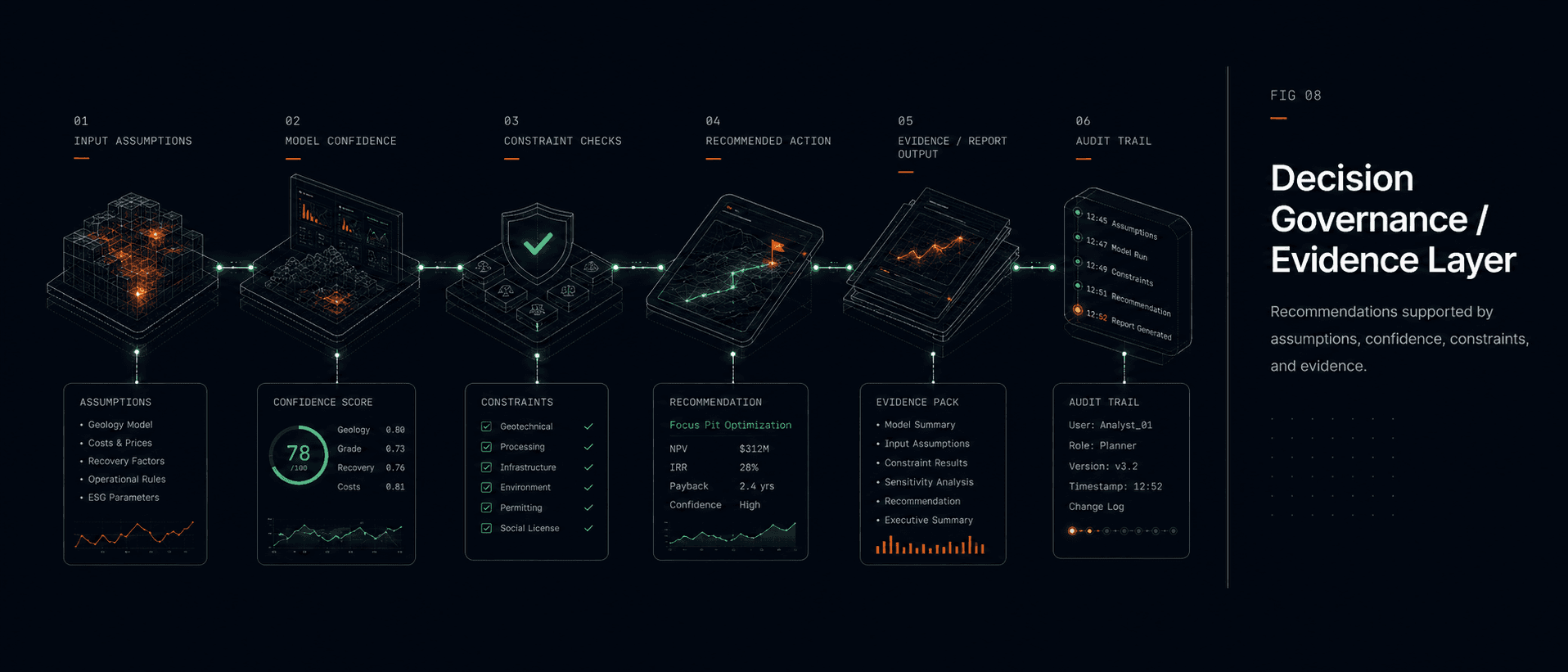
Decision governance / evidence layer

Supports recommendations with assumptions, model confidence, constraints, evidence, sensitivity context, and an audit trail.

Architecture role: Evidence pack with assumptions, confidence, sensitivity, constraints, and audit trail.

Connected data foundation

Unify the operating context before modelling the decision.

Unifies operational, geological, plant, laboratory, maintenance, energy, emissions, cost, and commercial data into one structured decision context.

What it connects
Block models, dispatch, fleet, historian, laboratory, maintenance, energy, emissions, cost, and commercial systems.
What the user gets
A governed baseline view of the signals, sources, time windows, and definitions behind the decision.
Decision improved
Cross-functional review, model setup, baseline diagnostics, and scenario readiness.
Example output
Source map, data-quality context, and baseline decision view.
OreNeda connected data foundation unifying geology, fleet, processing, laboratory, energy, emissions, maintenance, and commercial data sources.
Scenario intelligence

Compare operating pathways before consequences appear downstream.

Compares operational alternatives before decisions become downstream consequences, with visible trade-offs across throughput, recovery, energy, cost, emissions, and value.

What it connects
Operating constraints, model outputs, production targets, recovery response, energy intensity, costs, emissions, and product quality.
What the user gets
Side-by-side operating alternatives with the assumptions, constraints, sensitivities, and KPI movement visible.
Decision improved
Blast design, routing, blending, plant settings, energy trade-offs, and production-risk decisions.
Example output
Ranked scenarios with expected trade-offs and a recommended pathway for review.
OreNeda scenario intelligence view comparing operational alternatives before downstream consequences appear.
Resource-to-product traceability

Follow material, performance, and value from resource to product.

Follows material, performance, and value from resource model to final product so teams can understand where outcomes were created, lost, or shifted.

What it connects
Block model, drilling, blasting, haulage, stockpile, crushing, grinding, processing, and product-quality records.
What the user gets
A traceable material story that links source context to downstream performance, quality, and value movement.
Decision improved
Mine-to-mill review, reconciliation, feed-risk diagnosis, and product-quality investigation.
Example output
Resource-to-product lineage with performance, value, and confidence context.
OreNeda resource-to-product traceability spine following material, performance, quality, and value across the mining chain.
Operational-period visibility

Monitor constraints and operating signals across the value chain.

Monitors constraints, KPIs, and operating signals across the mining value chain at the timing supported by site integration: near-real-time, shift-level, or operational-period visibility.

What it connects
Shift KPIs, equipment state, alarms, plant signals, stockpile state, production targets, maintenance risk, and material movement.
What the user gets
A shared operating picture for constraints, warnings, data freshness, and KPI movement across mine and plant.
Decision improved
Short-interval control, shift review, dispatch response, plant control, and constraint escalation.
Example output
Operational-period control view with warnings, priorities, and decision context.
OreNeda operational visibility view monitoring constraints, KPIs, freshness, and operating signals across the mining value chain.
Decision governance / evidence layer

Support every recommendation with evidence teams can review.

Supports recommendations with assumptions, model confidence, constraints, evidence, sensitivity context, and an audit trail.

What it connects
Source data, assumptions, model confidence, constraints, scenario results, recommended actions, owners, and review status.
What the user gets
A recommendation record that explains why the action was proposed and what limits it respects.
Decision improved
Technical challenge, approval workflows, audit readiness, partner review, and site validation.
Example output
Evidence pack with assumptions, confidence, sensitivity, constraints, and audit trail.
OreNeda decision governance layer showing assumptions, model confidence, constraints, evidence pack, and audit trail.
Where it can be configured

Start focused, then expand across the operation.

OreNeda does not need to be deployed as a full value-chain transformation on day one. It can begin around a priority decision workflow and expand as data maturity, adoption, and operational confidence grow.

GeologyDrillingBlastingLoad and haulStockpilesCrushingGrindingProcessingMaintenanceEnergyEmissionsCostReporting
Integration

A decision layer above the systems you already run.

OreNeda is designed to sit above existing operational, geological, plant, and business systems. It is partner-friendly by design: a decision layer for connecting specialist tools, not a replacement for fleet, historian, automation, planning, or modelling platforms.

Geological and block models

Fleet, dispatch, and shift systems

Plant historians and process data

Laboratory and product quality

Maintenance and asset systems

Energy, emissions, and cost systems

Pilot readiness

Prove value around a focused workflow.

A practical pilot should produce a working decision view, a scenario comparison, and an evidence pack that site experts can challenge.

01

Define the operating question

02

Map available data and systems

03

Build the baseline operating view

04

Configure value-chain models and KPIs

05

Compare scenarios

06

Validate outputs with site experts

07

Deliver a decision dashboard and evidence pack

Connect the value chain

Ready to turn mining data into better operational decisions?

OreNeda is designed for mining teams, partners, and investors who need a credible path from data to decision.

Validate a decision workflow.

Request a demo